09. From Development to Deployment
Untitled
From Development to Deployment
What happens during this period?
ND036 C3 L2 06 From Development To Deployment
ND036 C3 L2 06.1 From Development To Deployment
ND036 C3 L2 06.2 From Development To Deployment
From Development to Deploy Recap
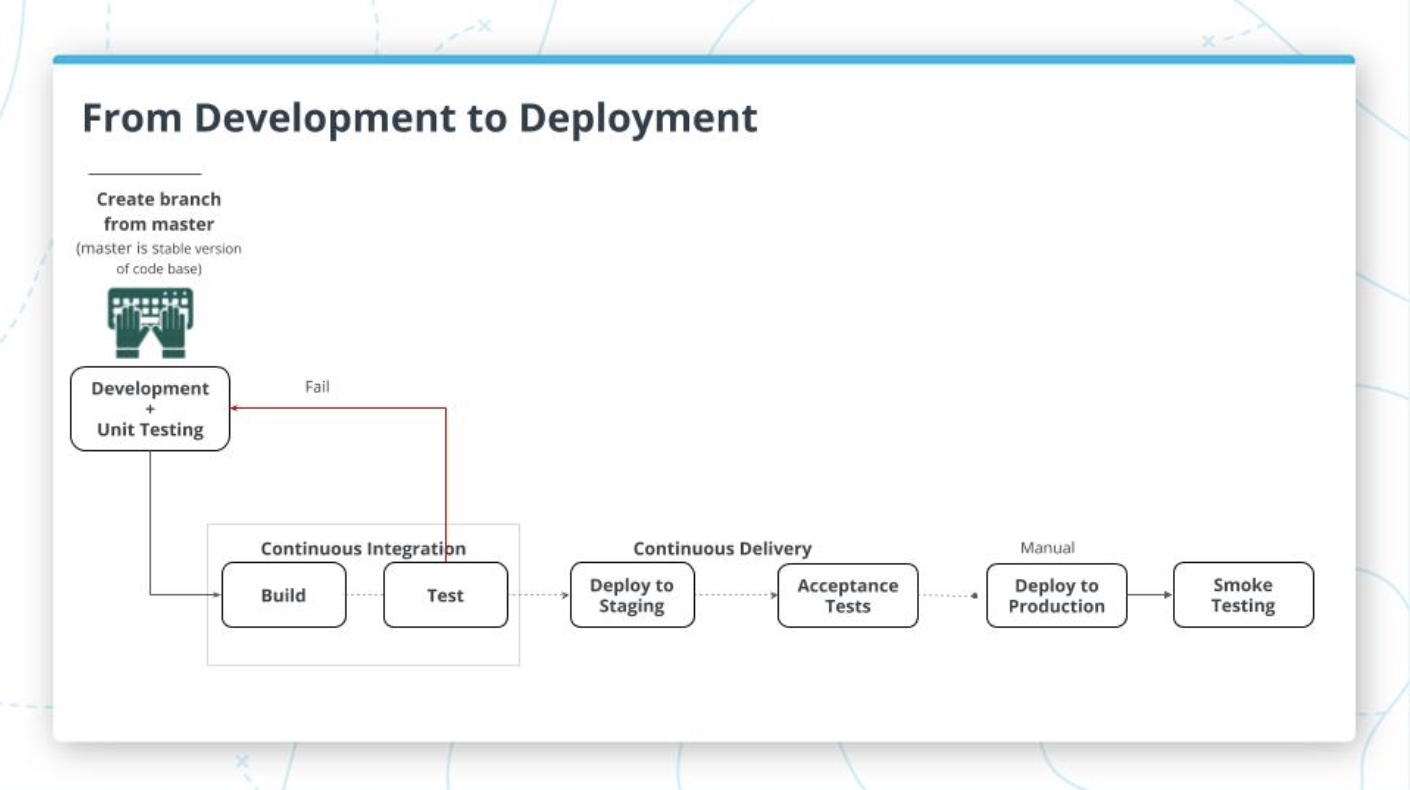
From Development to Deployment Summary
The development team uses a version control system to track all the changes made to the codebase, manage and view the changes made in a specific part of the codebase easily. It also allows the development team to restore the codebase to a stable version when undesirable or unstable changes are added to the code base.
- Developers always start with the most current and stable version of codebase called the master or main trunk and make a copy (called as a branch) to their local environment.
- Once the developer adds new features or makes modifications to an existing feature, they write and execute test cases to ensure their modified code passes. This is called unit testing.
- When developers merge their unit-test verified code directly, conflicts may occur. Many teams adopt continuous integration, where the modified codebase is validated by running automated tests. This helps the development team identify and resolve conflicts earlier and improve delivery speed
- Continuous delivery is an extension of continuous integration, where the latest version of the master is deployed automatically to an internal environment called staging.
- QA team conducts comprehensive and exhaustive manual testing in the staging environment. The product manager conducts user acceptance testing, feature demo and sign-off with internal stakeholders here.
- In most companies deployment to production is manual
- After deploying the latest version of the codebases to production, smoke tests are run to verify whether basic functions and critical features are working as expected
From Development to Deployment Quiz